×

Info

Login to view document

EORI Library
Find publications about Enhanced Oil Recovery (EOR).

Presentations

Presentations
Display:

Nick Jones of EORI explores the application of Permian Basin ideas to the Bighorn Basin through the use of cores, cuttings, well logs, PI cards, and more.

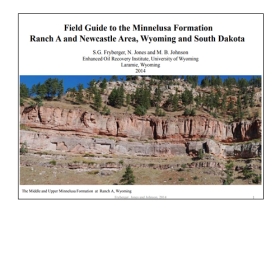
Field Guide to the Minnelusa Formation Ranch A and Newcastle Area, Wyoming and South Dakota
 4.95 MB
Author:

Eolian petroleum reservoirs are found worldwide, many having high-volume production of both oil and gas. As with any geological rock unit, each oil/gas field has production characteristics peculiar to its geological history. However, certain common factors link most eolian reservoirs. Cross-stratification due to bedform migration can influence sweep direction and efficiency. The various kinds of primary eolian strata have different poroperm characteristics. Moreover, stacking of sand seas or bedforms through geological time can create distinctive reservoir flow units in the subsurface. Tectonic activity, especially faults, may create shear zones with reduced poroperm, or partition a reservoir into structurally defined flow units. Faults may also create high-permeability zones that allow water breakthrough. Eolian reservoirs are commonly thought of as clean, and rather simple. However, in some places they are complex in terms grain composition or texture. They are commonly cemented by carbonates, anhydrites or salt, which sets up fabricselective or non-fabric selective patterns of secondary porosity in reservoirs.


A review of basic principles of eolian deposition, with illustrations from the modern and ancient sediments.

This presentation addresses the benefit of increased spatial (lateral) and temporal (vertical) resolution using three-dimensional (3D) seismic data in Minnelusa field development.

A case history of Donkey Creek North Minnelusa Oil Field, T50N-R68W, Crook County, Wyoming demonstrates that acquiring high quality 3D seismic data directly benefits strategic placement of well bores to increase oil
production in both primary and secondary recovery programs.

Reservoir Modeling in Minnelusa (Case Study)
 11.6 MB
Author:

Discussion of a case study in reservoir modeling in the Minnelusa which addresses geology, production history, porosity, temperature and fluid properties, and history matching.

The law and economics of CO2 as a pollutant and commodity
 484.47 KB
Author:

  • We think of CO2 as the greenhouse gas (GHG) causing global warming.
  • The Stern Report and the several IPCC (Intergovernmental Panel on Climate Change) reports are gaining acceptance.
  • In its most recent report (AR4 Synthesis Report November 17, 2007) the IPCC has written: Warming of the climate system is unequivocal, as is now evident from observations of increases in global average air and ocean temperatures, widespread melting of snow and ice, and rising global average sea level.
  • The report goes further to say: Most of the observed increase in globallyaveraged temperatures since the mid-20th century is very likely due to the observed increase in anthropogenic GHG concentrations.
  • The Supreme Court on April 2, 2007 in a 5 to 4 decision decided that CO2 was a pollutant and the EPA could regulate auto emissions of the GHG (Chemical & Engineering News, April 3, 2007).